Building Foundations: The Critical Element That Determines Structural Stability Foundation is not just the base of a structure—it is the fundamental element that decides the stability of the entire building. Whether you're constructing a modest re…
Building Foundations: The Critical Element That Determines Structural Stability
Foundation is not just the base of a structure—it is the fundamental element that decides the stability of the entire building. Whether you're constructing a modest residential home or a towering skyscraper, the foundation system must be carefully designed and executed to ensure long-term structural integrity, safety, and performance. This comprehensive guide explores the essential types of foundations, their applications, and the critical factors that determine which foundation system is appropriate for your construction project.
Understanding Building Foundations: The Invisible Foundation of Safety
A building foundation is the structural element that connects a structure to the ground, serving as the critical interface between the superstructure (the visible portion of the building) and the earth that supports it. The primary purpose of any foundation is to safely transfer and distribute the weight of load-bearing walls, columns, floors, roofs, and all other structural components directly to the underlying soil or rock.
Without a properly designed and constructed foundation, even the most impressive architectural designs will ultimately fail. Foundations work by spreading structural loads over a sufficiently large area to prevent excessive settlement, bearing capacity failure, or structural collapse. The loads transmitted through foundations typically exceed 1,000 kPa (kilopascals), while soil bearing capacity commonly measures less than 400 kPa—making the load distribution function of foundations absolutely essential.
The Two Primary Categories of Foundations
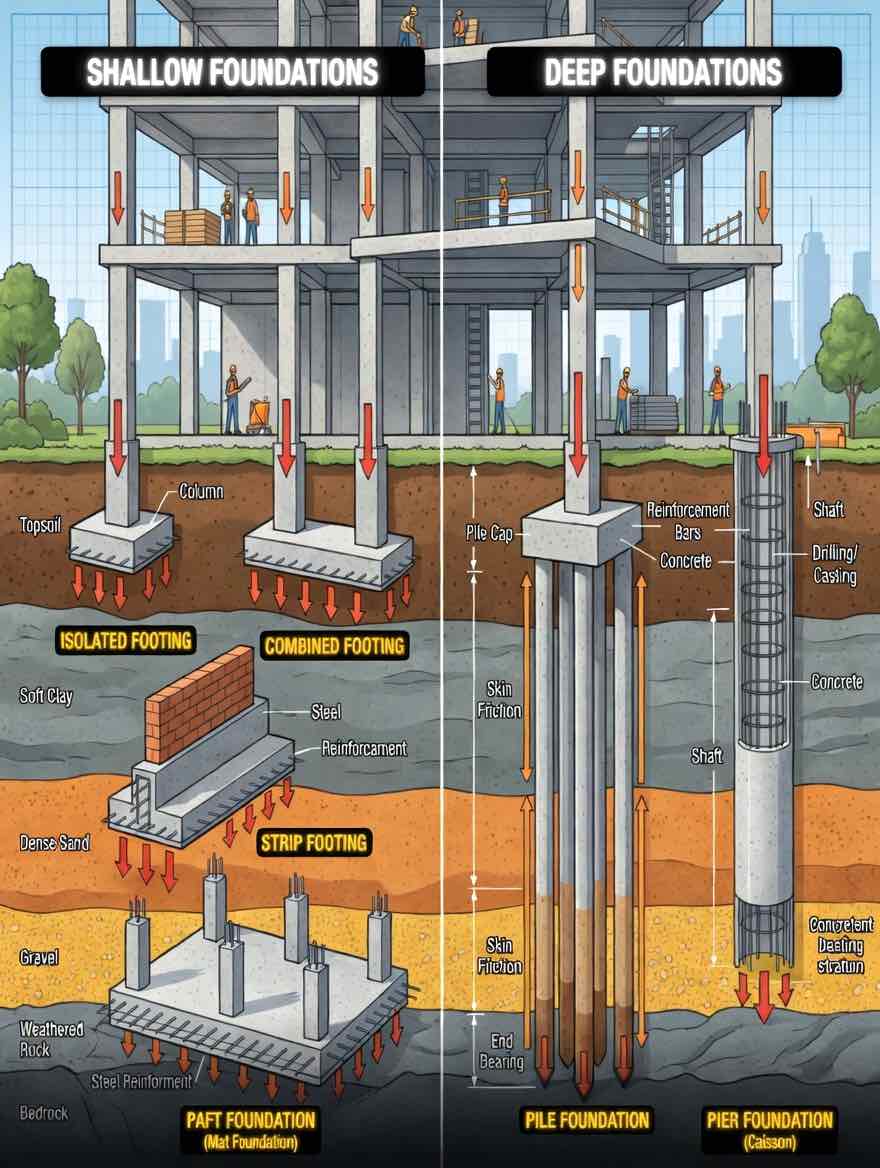
Foundations are broadly classified into two fundamental categories based on their depth relative to their width and the soil layers they engage:
1. Shallow Foundations: Foundations where the depth is less than or equal to the width, transferring loads to earth very near the ground surface
2. Deep Foundations: Foundations where the depth is greater than the width, transferring loads to deeper soil layers or bedrock far below the surface
The selection between shallow and deep foundations depends on multiple critical factors including soil bearing capacity, groundwater conditions, structural loads, site constraints, and economic considerations.
Shallow Foundations: Economical Solutions for Adequate Bearing Soils
Shallow foundations, also called footings, are positioned beneath the lowest part of the structure. Generally, when the depth of foundation is less than or equal to its width (typically less than six feet deep), it is classified as a shallow foundation. These are the most economical and widely used foundation systems for relatively light structures, requiring less excavation, less reinforcement, and simpler construction procedures than deep foundations.
Shallow foundations are suitable only when the soil near the surface has adequate bearing capacity and limited settlement characteristics. The soil below shallow foundations is usually prepared by leveling and compaction, but no deep excavation is required.
Types of Shallow Foundations
1. Isolated Footing (Pad Footing or Spread Footing)
Isolated footing is the most commonly used type of shallow foundation and the most economical option. This foundation type supports a single column or pier, distributing its load uniformly over the underlying soil.
Characteristics:
Also known as column footing, pier footing, or pedestal footing
Generally square or rectangular in shape, though circular designs are also used
Constructed using reinforced concrete with steel reinforcement provided to resist bending moments developed due to soil pressure
Typically used for ordinary buildings up to five stories
When to Use:
Columns are widely spaced and their footings would not overlap
Surface soil has adequate bearing capacity
Structural loads are relatively low
Ground is stable with no risk of differential settlement
Most economical choice for evenly spaced columns in residential buildings
Design Considerations:
The footing acts like a cantilever beam exposed to soil pressure from the bottom
This creates tension at the bottom and compression at the top
Since concrete is weak in tension but strong in compression, main reinforcement must be placed at the bottom
Minimum reinforcement can be added at the top for crack control
Footings are always wider than the columns they support to distribute pressure effectively
Advantages:
Simple and economical construction
Straightforward design process
Easy to construct basements
Reduced risk of foundation cracking
Suitable for most residential and light commercial applications
Limitations:
Requires good soil bearing capacity at shallow depth
Not suitable for closely spaced columns
Cannot be used when soil is weak or compressible
Differential settlement can be an issue if soil conditions vary across the site
2. Combined Footing
Combined footing is provided when two or more columns are close to each other such that their individual isolated footings would overlap. This foundation type uses a single footing to support multiple columns.
Characteristics:
Supports two or more columns with a single continuous footing
Usually rectangular or trapezoidal in shape
When loads among columns are equal, the footing may be rectangular
When loads are unequal, a trapezoidal shape helps maintain uniform pressure distribution
When to Use:
Columns are placed close to each other and individual footings would overlap
A column is located near the property line and cannot have a symmetrical footing extending beyond the boundary
Bearing capacity of soil is low and needs to be distributed over a larger area
Dimensions of one side of the footing are restricted to some lower value
To prevent eccentric loading conditions
Design Objective: The main goal is uniform distribution of loads under the entire area of footing. This requires coinciding the center of gravity of the footing area with the center of gravity of the total loads from all supported columns.
Types of Combined Footings:
Rectangular Combined Footing: Used when columns carry similar loads
Trapezoidal Combined Footing: Used when column loads are significantly different
Slab Type: Simple continuous slab
Slab and Beam Type: Incorporates beams for additional strength
Advantages:
Prevents eccentric loading near property lines
Economical when columns are closely spaced
Ensures uniform load distribution
Reduces differential settlement risk
3. Strip Footing (Wall Footing or Continuous Footing)
Strip footing is a continuous slab strip provided under load-bearing walls or a row of closely spaced columns. This foundation runs beneath the entire length of the wall to help maintain structural stability.
Characteristics:
Continuous foundation running along the wall length
Width typically twice the wall thickness or more
Constructed using stone, brick, reinforced concrete, or masonry
Acts as a long continuous beam supporting the wall above
When to Use:
Supporting load-bearing walls in traditional construction
Row of columns placed in a line at close intervals
Perimeter walls require continuous support
Compound walls or boundary walls
Loads to be transmitted are of relatively small magnitude
Foundation is placed on dense sand and gravel
Applications:
Residential building perimeter walls
Retaining walls
Boundary and compound walls
Commercial building load-bearing walls
Bridge abutments
Advantages:
Best for continuous loads from walls
Cost-effective for linear structures
Simple construction process
Provides continuous support
Reduces differential settlement along wall length
4. Raft Foundation (Mat Foundation)
A raft foundation consists of a reinforced concrete slab or T-beam slab placed over the entire area of the structure, with the whole basement floor slab acting as the foundation. The total load of the structure is spread evenly over the entire area, like a vessel floating on a sea of soil—hence the name "raft."
Characteristics:
Single large continuous rectangular or circular slab under the entire building
Covers the complete building footprint or major portions
Typically restricted to 300mm thickness for economic reasons, though thicker designs are used for heavy loads
Can be plain flat plate or include beams and thickened areas
When to Use:
Soil bearing capacity is inadequate for individual footings
Soil at shallow depth is compressible or weak but relatively uniform
More than 50% of the plan area would be covered by individual or combined footings
Heavy and non-uniform loads from the superstructure are imposed
Columns are closely placed such that individual footings would overlap
Structure includes a basement
Differential settlement must be prevented
Other types of foundations are not feasible or more expensive
Soil strata are unpredictable and contain pockets of compressible soil
Structure is subjected continuously to shocks or jerks
Types of Raft Foundations:
Flat Plate Mat: Simplest form, used when columns and walls are uniformly spaced at small intervals with relatively small loads
Plate Thickened Under Columns: Additional thickness at column locations to handle concentrated loads
Two-Way Beam and Slab: Grid of beams running in both directions with slab in between
Piled Raft: Raft foundation supported on piles, used when soil at shallow depth is highly compressible and water table is high
Design Characteristics:
Functions like a continuous beam with uniform soil pressure from bottom
Column loads act as supports (inverted beam concept)
Main reinforcement at top at mid-spans where tension occurs
Main reinforcement at bottom at supports (column locations)
Requires careful analysis of load distribution and soil reaction
Advantages:
Distributes load uniformly over large area
Reduces differential settlement significantly
Economical when more than 50% of area needs footings
Provides basement floor simultaneously
Suitable for weak soils with uniform compressibility
Can support multiple columns and walls simultaneously
Limitations:
Higher initial cost than isolated footings for small buildings
Requires more concrete and reinforcement
Complex design and analysis required
Excavation of large area needed
Not suitable for highly variable soil conditions
Deep Foundations: Solutions for Challenging Soil Conditions
Deep foundations are required when the uppermost layers of earth cannot support the structural loads due to inadequate bearing capacity, excessive compressibility, or other unfavorable conditions. These foundations transfer structural loads to deeper soils or rock layers that are denser and less compressible, extending beyond 300 feet below surface elevation in extreme cases but typically terminated between 20 to 100 feet.
A foundation is described as 'deep' when its depth is more than three times its breadth. Deep foundations are usually used for large structures and in situations where shallow foundations would result in excessive settlement, cannot resist uplift forces, or are simply not feasible.
When Deep Foundations Are Necessary
Deep foundations become essential in several situations:
Surface soil bearing capacity is inadequate
Soil at shallow depth is compressible or weak
Groundwater table is high
Heavy and non-uniform loads from superstructure are imposed
Structure is located near river beds or seashores with scouring potential
Canal or deep drainage system is near the structure
Soil excavation to desired depth is impossible due to poor conditions
Foundation trenches cannot be kept dry by pumping due to heavy seepage
Structure requires resistance to uplift forces
Lateral loads are significant (bridges, towers, marine structures)
Site constraints like property lines prevent adequate shallow foundation dimensions
Types of Deep Foundations
1. Pile Foundation
Pile foundations are the most common type of deep foundation, consisting of long, slender, columnar elements typically made from steel, reinforced concrete, or sometimes timber. Foundation piles are used for large structures and transfer loads through weak or unstable ground to stronger, more stable soil or rock layers below.
Fundamental Characteristics:
Long, slender columns driven or drilled deep into the ground
Typically range from 2 inches to several feet in diameter
Can extend to depths of 100 feet or more
Transfer loads through end-bearing, friction, or combination of both
Made from precast or cast-in-place concrete, steel, or timber
Load Transfer Mechanisms:
End-Bearing Piles: These piles transfer loads directly to a firm stratum (bedrock or dense soil) at the pile tip. The pile acts like a column, resting on a strong layer well below the surface. The load is transferred through the tip to the bearing stratum.
Friction Piles (Floating Piles): These piles develop surface friction along their length to resist loads. The pile transfers load to the surrounding soil through skin friction between the pile surface and the soil. They are used when no firm bearing stratum exists at reasonable depth.
Combination Piles: Most piles derive capacity from both end-bearing and friction, though one mechanism typically dominates.
Classification by Installation Method:
Driven Piles:
Prefabricated piles driven into ground using pile drivers
Made of precast concrete, steel, or timber
Installation creates noise and vibration
Displaces soil, increasing lateral pressure
Quality can be verified before installation
Cannot be installed in areas with overhead restrictions
Bored Piles (Drilled Shafts, Cast-in-Place):
Hole drilled using mechanical auger or rotary drilling rig
Steel reinforcement placed in hole
Concrete poured to form pile
Minimal noise and vibration during installation
Can be 2 to 30 feet in diameter
Suitable for urban areas with noise restrictions
Quality depends on construction control
Auger Cast Piles:
Constructed using continuous flight hollow stem auger
Typically 12 to 24 inches diameter
Grout pumped through hollow auger as it's withdrawn
Best suited for soft to medium dense soil
Minimal noise and vibration
Screw Piles (Helical Piles/Piers):
Steel shaft with helical plates creating screw-like device
Rotated into ground like a screw
Suitable for tension and compression loads
Minimal soil disturbance
Can be installed in limited access areas
Types by Material:
Concrete Piles:
Precast reinforced concrete driven into place
Cast-in-place concrete poured in drilled holes
High compressive strength
Durable and long-lasting
Suitable for most soil conditions
Steel Piles:
H-sections, pipes, or tubes
High strength-to-weight ratio
Easy to splice for greater depths
Can penetrate dense layers
Suitable for marine environments (with proper coating)
May corrode in aggressive soils
Timber Piles:
Traditional material, less common today
Suitable for light to moderate loads
Economical for temporary structures
Limited by length and diameter available
Susceptible to decay above water table
Requires treatment for durability
Micropiles (Mini Piles, Pin Piles):
Small diameter piles (typically 3 to 10 inches)
High-strength steel casing and/or threaded bars
Friction piles achieving higher capacities at lesser depths
Ideal for limited access locations
Can be installed with small equipment
Competitive cost per kip in poor soils
Advantages of Pile Foundations:
Suitable for very poor surface soils
Can reach load-bearing strata at any depth
High load-carrying capacity
Resistant to uplift forces
Suitable for marine and waterfront structures
Can be installed in various soil conditions
Proven long-term performance
Limitations:
Higher cost than shallow foundations
Requires specialized equipment and expertise
Noise and vibration during installation (driven piles)
Difficult to verify pile integrity after installation
May encounter obstructions during installation
Requires careful quality control
2. Pier Foundation (Caisson Foundation)
Pier foundations use large diameter cylindrical columns constructed below the ground to support the superstructure and transfer heavy loads to firm soil strata or rock. They are particularly suitable for bridges, dams, high-rise buildings, and structures on weak or unstable soil.
Fundamental Characteristics:
Large diameter cylindrical deep foundations
Generally 2 to 30 feet in diameter (larger than piles)
Constructed by excavating or drilling and filling with concrete
Often include manual inspection of excavation
Also known as post foundations or column foundations
Invariably include concrete/masonry construction
Distinction from Piles: The primary differences between piers and piles include:
Diameter: Piers are larger diameter (generally minimum 2 feet)
Material: Piers invariably use concrete/masonry, while piles can be steel, wood, or concrete
Installation: Piers use excavation large enough for manual inspection; piles are driven or drilled without inspection
Terminology: Terms often used interchangeably, but technical definitions distinguish them
Hole drilled into ground using specialized equipment
Range from 2 to 30 feet diameter
Can exceed 300 feet in length
Filled with reinforcement and concrete
Commonly reinforced with steel cages
Can be straight-sided or have enlarged bases (bells)
Caissons:
Deep watertight structures
Most often used for bridge piers and waterfront structures
Can be floated to job site and sunk into place
Constructed above ground then sunk to required level
Material excavated from within as caisson descends
Types include open caissons, box caissons, and pneumatic caissons
Steel Piers:
High-strength steel driven deep into soil
Extreme load-bearing capacity
Suitable for heavy structures
Perform well in soft or expansive soils
Used for underpinning existing foundations
Concrete Piers:
Cast-in-place reinforced concrete
Can have enlarged bases to increase capacity
Suitable for most soil conditions
Widely used in bridge construction
Push Piers:
Hydraulically driven steel piers
Reach load-bearing strata below weak soils
Used to stabilize and lift settling foundations
Suitable for foundation repair
Helical Piers:
Steel piers with helical plates
Rotated deep into ground
Ideal for unstable or wet soils
Used for new construction and foundation repair
When to Use Pier Foundations:
Bridges crossing rivers, valleys, or roads
Multi-story buildings on weak surface soils
Waterfront and marine structures
Structures requiring elevation above flood levels
Heavy industrial facilities
When shallow foundations are not feasible
Sloping or uneven terrain
High groundwater conditions
Advantages:
Transfers loads to deep, stable strata
Can support extremely heavy loads
Suitable for difficult soil conditions
Minimal disturbance to surrounding soil
Economical for medium to heavy loads
Reduces flood risk by elevating structure
No ground vibration with drilled piers
Provides access space for utilities
Bearing capacity can be increased by under-reaming (enlarging base)
Design Considerations:
Soil investigation critical for determining pier depth and capacity
Load calculation must include all dead and live loads
Pier spacing affects load distribution
Connection to superstructure must be properly designed
Lateral load resistance must be evaluated
Settlement analysis required
Construction quality control essential
Critical Factors in Foundation Selection
Selecting the appropriate foundation type requires careful evaluation of multiple interrelated factors:
1. Soil Conditions and Bearing Capacity
The single most important factor in foundation selection is the bearing capacity and characteristics of the soil at the site:
Bearing Capacity: The maximum pressure soil can support without shear failure
Soil Type: Clay, sand, gravel, rock, or mixed soils behave differently
Compressibility: How much soil compresses under load affects settlement
Consistency: Uniform soil allows shallow foundations; variable soil may require deep foundations
Stratification: Location and characteristics of different soil layers
A geotechnical investigation provides essential data including soil borings, laboratory tests, and bearing capacity recommendations that guide foundation design.
2. Structural Loads
The magnitude and distribution of loads from the structure determine foundation requirements:
Dead Loads: Permanent weight of structure, finishes, and fixed equipment
Live Loads: Variable loads from occupants, furniture, snow, etc.
Load Distribution: Point loads from columns vs. distributed loads from walls
Load Magnitude: Light structures may use shallow foundations; heavy structures often require deep foundations
3. Groundwater Conditions
Water table elevation significantly impacts foundation selection and design:
High groundwater reduces soil bearing capacity (buoyancy effect)
Complicates excavation for shallow foundations
May require dewatering during construction
Affects material selection (corrosion protection)
Influences frost depth considerations in cold climates
4. Environmental Factors
Site-specific environmental conditions affect foundation choice:
Frost Depth: Foundations must extend below frost line to prevent heaving
Seismic Activity: Earthquake zones require special foundation design
Flood Zones: May require elevated foundations
Erosion: Near rivers or coastlines requires scour protection
Expansive Soils: Clay soils that swell when wet require special treatment
5. Economic Considerations
Budget constraints influence foundation selection:
Initial Cost: Shallow foundations typically less expensive than deep foundations
Construction Time: Affects project schedule and carrying costs
Long-term Maintenance: Some foundations require more maintenance
Equipment Availability: Specialized equipment for deep foundations adds cost
Material Costs: Local material availability affects economy
6. Site Constraints
Physical limitations at the construction site may dictate foundation type:
Property Lines: May prevent adequate footing dimensions
Access: Limited access may preclude large equipment
Adjacent Structures: Existing buildings may limit excavation depth or method
Utilities: Underground utilities affect foundation placement
Overhead Restrictions: Power lines may prevent pile driving
7. Building Function and Design
The intended use and design of the structure influences foundation requirements:
Basement Requirements: Need for basement favors raft or deep basements
Column Spacing: Wide spacing favors isolated footings; close spacing favors combined or raft
Future Expansion: May require oversized or adaptable foundations
Sensitivity to Settlement: Some structures tolerate more settlement than others
Foundation Design Requirements
All foundations must satisfy fundamental design criteria regardless of type:
Safety Against Bearing Capacity Failure
The foundation must not exceed the soil's ultimate bearing capacity with appropriate safety factors. This prevents shear failure of the underlying soil that would cause catastrophic collapse.
Control of Settlement
Foundations must limit both total settlement and differential settlement to acceptable levels:
Total Settlement: Overall downward movement of foundation
Controlling differential settlement is often the design driver, as uneven movement causes cracking, jamming of doors and windows, and potential structural damage.
Structural Adequacy
The foundation itself must be structurally sound:
Adequate thickness to resist internal stresses
Proper reinforcement to handle bending and shear
Sufficient depth to reach competent bearing strata
Appropriate dimensions to distribute loads effectively
Construction Best Practices
Proper construction ensures foundation performance matches design intent:
Site Preparation
Clear vegetation and topsoil
Establish accurate survey control
Verify soil conditions match design assumptions
Provide adequate drainage during construction
Excavation
Excavate to specified depth and dimensions
Protect excavation sides from collapse
Keep excavation dry (dewatering if necessary)
Inspect bearing surface before placing concrete
Remove loose or unsuitable material
Materials Quality
Use specified concrete mix designs
Properly store and handle reinforcement
Protect materials from contamination
Verify material certifications
Reinforcement Placement
Position reinforcement as specified in drawings
Maintain proper concrete cover
Secure reinforcement to prevent displacement during concrete placement
Ensure proper bar sizes, spacing, and development lengths
Cause: High water table, poor drainage, inadequate waterproofing Solution: Improve site drainage, install drainage systems, proper waterproofing
Conclusion: Foundation as the Cornerstone of Structural Success
The foundation truly is not just the base of a structure—it determines the stability, safety, and longevity of the entire building. Whether selecting isolated footings for a simple residential structure or designing a complex pile foundation system for a major high-rise, the foundation engineer must carefully evaluate soil conditions, structural requirements, environmental factors, and economic constraints.
Shallow foundations—including isolated footings, combined footings, strip footings, and raft foundations—provide economical solutions when surface soils offer adequate bearing capacity. These systems are widely used, relatively simple to construct, and proven effective for small to medium structures.
Deep foundations—particularly pile foundations and pier foundations—become necessary when surface soils cannot support structural loads or when other conditions preclude shallow foundations. While more expensive and complex, these systems reliably transfer loads to competent strata deep below the surface, enabling construction of major structures on challenging sites.
The selection between foundation types requires comprehensive site investigation, careful engineering analysis, and thorough understanding of both geotechnical principles and structural requirements. A properly designed and constructed foundation will support the structure throughout its design life with minimal maintenance, while an inadequate foundation can lead to catastrophic failure regardless of the quality of construction above ground.
In the hierarchy of building components, foundations may be invisible once construction is complete, but they remain the most critical element—the literal and figurative foundation upon which all else depends. Every successful construction project begins with the same essential truth: a building is only as good as its foundation.




No comments:
Post a Comment