In the world of structural engineering and high-quality construction, the difference between a building that stands for decades and one that fails under stress often lies in the smallest details. One such detail is the Hook Length, specifically the 9d specification found in reinforced concrete detailing.
Understanding these technical specifications is vital for ensuring site safety, material efficiency, and structural longevity.
What is Hook Length in Rebar?
Reinforcing bars (rebars) are embedded in concrete to provide tensile strength. However, for the rebar to do its job, it must be "anchored" so it doesn't slip out when the structure is under load. While straight development length is often enough, space constraints in beams and columns usually require the rebar to be bent at the ends. This bend is called a hook.
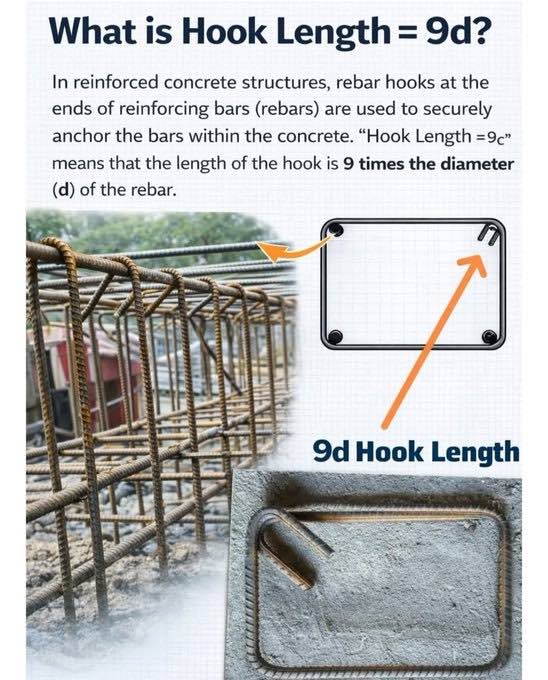
The Hook Length is the total length of the bend, including the curved portion and the straight extension that follows.
The Math Behind "9d"
The term 9d is a technical formula used by engineers and steel fixers to calculate the precise amount of extra rebar needed for an anchorage hook.
Technical Calculation Example
If you are using a standard 10mm rebar for stirrups (links), the calculation for a 9d hook would be:
$$9 \times 10\text{mm} = 90\text{mm}$$
| Rebar Diameter (d) | Formula | Required Hook Length |
| 8 mm | $9 \times 8$ | 72 mm |
| 10 mm | $9 \times 10$ | 90 mm |
| 12 mm | $9 \times 12$ | 108 mm |
| 16 mm | $9 \times 16$ | 144 mm |
The Engineering Function of the 9d Hook
The 9d specification is not arbitrary. It serves three critical functions:
1. Superior Anchorage
In "congested" areas like beam-column joints, there isn't enough room for a long straight bar. The 9d hook provides the necessary friction and mechanical interlock within the concrete to ensure the bar reaches its yield strength without pulling out.
2. Seismic Resistance
The image highlights the use of these hooks in stirrups (also known as links or ties). In the event of an earthquake or heavy vibration, concrete can crack and "spall" (fall off). A 135-degree hook with a 9d extension ensures that the stirrup remains anchored in the core of the concrete, preventing the vertical rebars from buckling.
3. Stress Distribution
The bend allows for a more gradual transfer of stress from the steel to the surrounding concrete, reducing the risk of localized crushing or splitting of the concrete at the point of anchorage.
Critical Evaluation: Why 9d Matters for Your Project
Using a hook shorter than the specified 9d (e.g., 4d or 6d) is a common shortcut on many construction sites, but it introduces significant risks:
-
Bond Failure: The rebar may slip under maximum load, leading to sudden structural collapse.
-
Code Non-Compliance: Most modern building codes in Kenya and internationally require specific minimum hook lengths for "seismic hooks" (typically 135-degree bends).
-
Reduced Ductility: The structure becomes "brittle," meaning it will fail abruptly rather than giving warning signs through gradual deformation.
When inspecting steelwork on-site, ensure that the "tail" of the stirrup follows the 9d rule. This ensures that the reinforcement cage remains rigid during the concrete pour and provides the life-saving structural integrity the building requires once occupied.
Does your current project involve high-rise construction or standard residential units? The required hook length can sometimes vary based on the specific seismic zone of your site.


No comments:
Post a Comment